


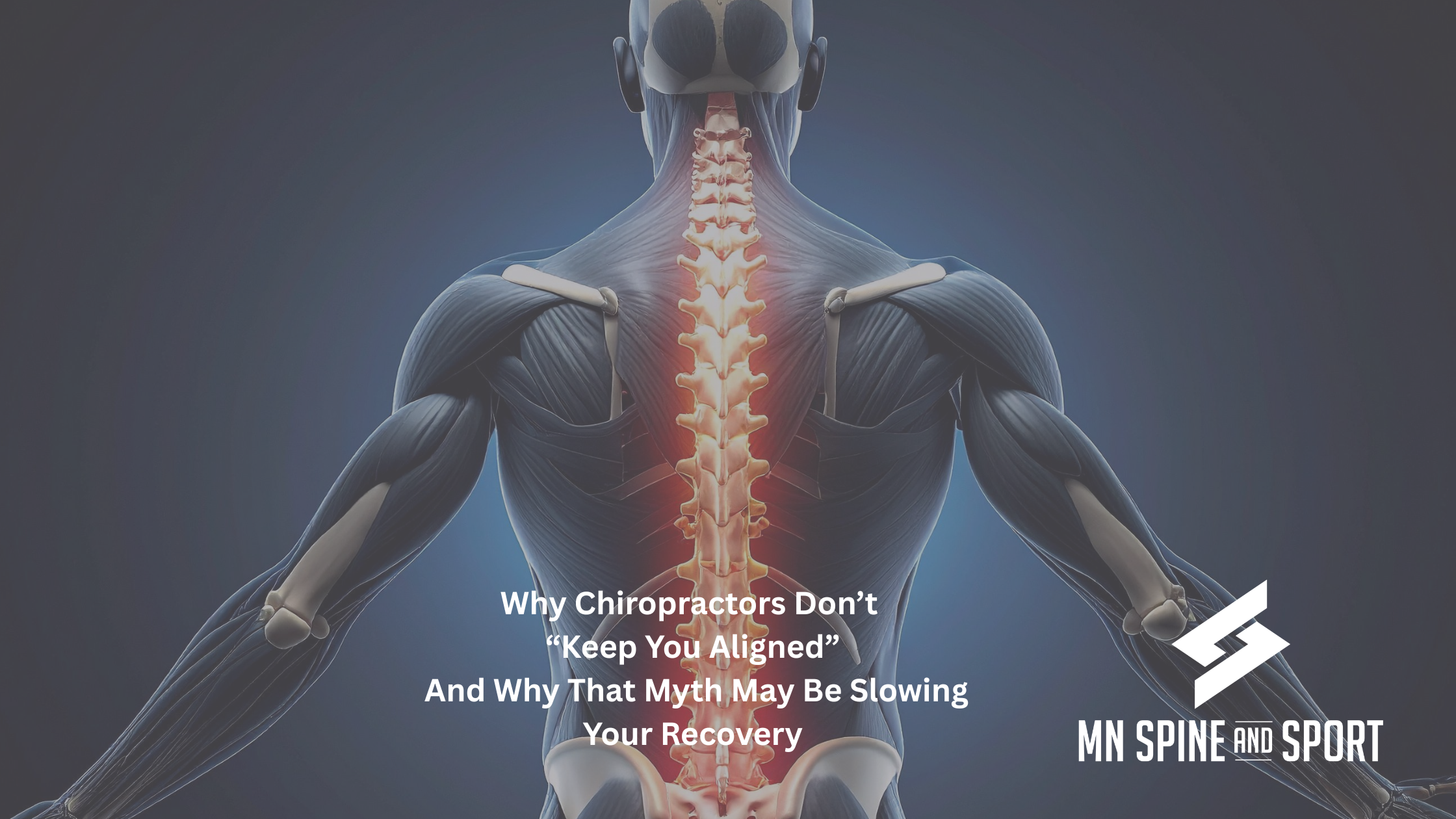
If you have ever been told that you need ongoing chiropractic care to stay aligned, you are not alone. This belief has been widely circulated for decades and has shaped how many people think about chiropractic care, spinal alignment, and back pain treatment. The problem is that it is not rooted in modern science, and more importantly, it can actually delay your recovery.
At MN Spine and Sport, we take a very different approach. Our goal is not to make you dependent on care. Our goal is to help you move better, feel better, and live better by addressing the true cause of your pain using evidence based chiropractic and rehabilitation.
The concept of spinal misalignment suggests that your bones move out of place and need to be put back regularly. While that idea sounds logical, research does not support the notion that small positional changes in the spine are the primary cause of pain. In fact, studies have shown that structural findings such as disc bulges and degeneration are extremely common in people with no symptoms at all. This tells us something important. Structure alone does not equal pain.
Your body is not fragile. It is adaptable, resilient, and constantly changing. Pain is influenced by many factors including movement patterns, strength, stress, sleep, and nervous system sensitivity. Focusing only on alignment ignores these critical drivers of chronic pain and musculoskeletal dysfunction.
Believing that your body is constantly falling out of alignment can actually interfere with your recovery. It often creates fear and dependency. If you think your spine is unstable or easily misaligned, you may become fearful of movement. This fear can lead to avoidance of activity, which is one of the biggest contributors to chronic pain. Research has shown that fear avoidance behaviors can worsen pain and disability over time.
This mindset also shifts focus away from what actually heals you. Recovery does not come from repeatedly putting things back into place. It comes from improving how your body moves and functions. Exercise, progressive loading, and active rehabilitation are consistently shown to be more effective for long term outcomes than passive treatments alone. If your care is focused only on alignment, you are missing the most important part of recovery.
Another major issue is that the alignment model ignores the role of the nervous system. Pain is not just a mechanical issue. It is influenced by how your brain and nervous system process signals. Modern pain science shows that increased sensitivity in the nervous system can amplify pain even when tissues are not significantly damaged. This is especially important for patients dealing with chronic low back pain, neck pain, or recurring injuries.
Many patients also find themselves stuck in a cycle of ongoing care without real progress. If the goal is simply to stay aligned, there is no clear endpoint. This can lead to months or even years of treatment focused on temporary relief rather than true recovery. Healthcare should focus on progress, not dependence.
This does not mean chiropractic adjustments are not valuable. They absolutely are. However, their benefit is not about realigning bones. Research suggests that chiropractic adjustments help improve joint mobility, reduce muscle tension, influence the nervous system, and provide short term pain relief. They create an opportunity for change, but they are not the entire solution.
True recovery comes from addressing the underlying causes of your pain. Movement quality plays a major role. Poor movement patterns can place excessive stress on tissues over time, leading to pain. Strength and stability are equally important. Your body needs the capacity to handle the demands you place on it, whether that is working, exercising, or daily activities.
Load management is another key factor. Injuries often occur when the stress placed on your body exceeds what it can handle. This can happen from doing too much too quickly or from repetitive strain over time. Proper progression allows your body to adapt and heal.
The nervous system also plays a critical role. Stress, sleep, and emotional health all influence pain levels. Addressing these factors can significantly improve recovery outcomes. Education is just as important. When patients understand what is happening in their body, they are less fearful and more confident in their recovery process.
At MN Spine and Sport, we do not subscribe to the outdated idea of keeping you aligned. We take a modern, evidence based approach focused on results. We look at the root cause of your pain by analyzing movement, strength, and function. We combine hands on care with active rehabilitation to create long term improvement, not just short term relief.
Every treatment plan is individualized based on your goals and lifestyle. Whether you are dealing with back pain, neck pain, sports injuries, or work injuries, our goal is to help you return to what you love without ongoing dependence on care. We focus on building independence, not creating reliance.
If you are tired of temporary fixes and want a real solution, the next step is to get a proper evaluation. You can schedule your appointment here:
👉 https://mnspineandsport.com/schedule-now/
The bottom line is that chiropractors do not keep you aligned because your body is not constantly falling out of place. Recovery is not about repeatedly fixing alignment. It is about improving how your body functions. When care focuses only on alignment, it can create fear, dependency, and delayed progress. When care focuses on movement, strength, and the nervous system, the results are completely different.
At MN Spine and Sport, we are committed to helping you recover the right way. Not by keeping you aligned, but by helping you become stronger, more resilient, and in control of your health.
References
Bialosky, J. E., Bishop, M. D., Price, D. D., Robinson, M. E., & George, S. Z. (2009). The mechanisms of manual therapy in the treatment of musculoskeletal pain. Manual Therapy, 14(5), 531–538.
Brinjikji, W., Luetmer, P. H., Comstock, B., Bresnahan, B. W., Chen, L. E., Deyo, R. A., et al. (2015). Systematic literature review of imaging features of spinal degeneration in asymptomatic populations. American Journal of Neuroradiology, 36(4), 811–816.
Hayden, J. A., van Tulder, M. W., Malmivaara, A., & Koes, B. W. (2005). Exercise therapy for treatment of non-specific low back pain. Annals of Internal Medicine, 142(9), 765–775.
Moseley, G. L. (2003). A pain neuromatrix approach to patients with chronic pain. Manual Therapy, 8(3), 130–140.
Vlaeyen, J. W. S., & Linton, S. J. (2000). Fear-avoidance and its consequences in chronic musculoskeletal pain. Pain, 85(3), 317–332.

GET STARTED
READY TO SCHEDULE NOW?
If you are a new patient, please fill out the New Patient Intake Form.