

If Every Step Hurts, You Deserve a Real Answer
Heel pain has a way of taking over your life. It changes how you walk. It makes you avoid workouts. It turns normal things—like walking the dog or standing at your child’s game—into a countdown until you can sit down again.
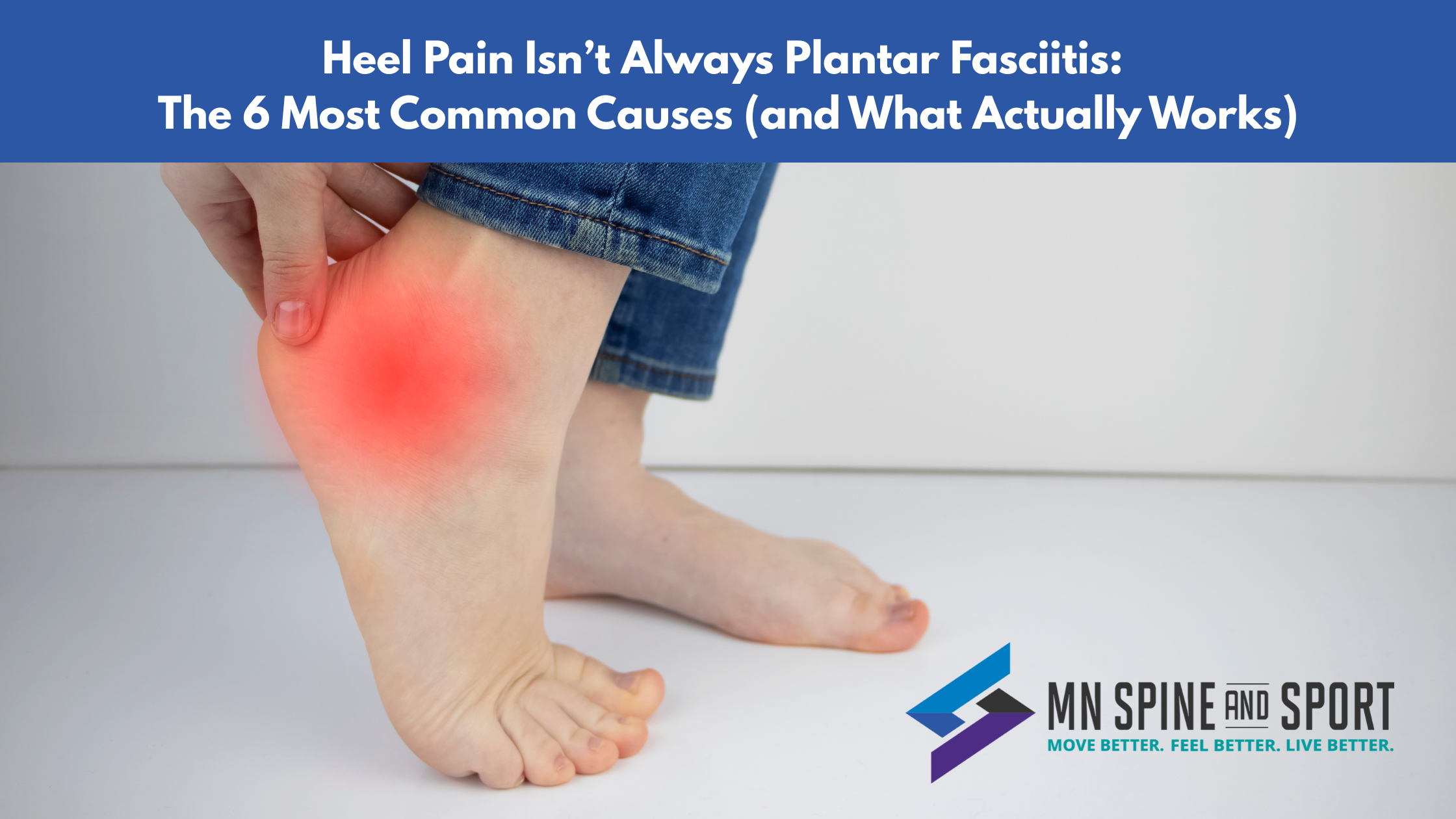
Most people assume heel pain is plantar fasciitis. And sometimes it is. But here’s the problem: heel pain is a location, not a diagnosis. If you treat the wrong thing, you can waste weeks (or months) doing the “usual fixes” with little progress.
At MN Spine and Sport in Woodbury, MN, we help people get to the root cause of heel pain by identifying what’s driving it—fascia, tendon, nerve, bone stress, or biomechanics—and then building a plan that actually works.
Why Heel Pain Is So Common (Especially in Winter)
Heel pain tends to spike in January because routines change:
- People start walking more or returning to the gym
- They jump back into running too quickly
- They wear different footwear (boots, flatter shoes, less support)
- They spend more time on hard floors indoors
- They move less overall, which can increase stiffness and tendon irritability
When you combine a sudden increase in load with stiff tissues and suboptimal footwear, heel pain becomes very likely.
Step One: Don’t “Diagnose Yourself” by Googling the Pain Spot
Here’s a common mistake: “It hurts on the bottom of my heel, so it’s plantar fasciitis.”
But bottom-of-heel pain can also be:
- Fat pad irritation (feels bruised)
- A nerve irritation (burning/tingling)
- A stress reaction in the calcaneus (heel bone)
- Referred pain from the back or calf
The key isn’t just where it hurts. It’s:
- when it hurts
- what activities worsen it
- how it feels (sharp, burning, bruised, stiff)
- how your walking mechanics look
Let’s break down the most common causes.
The 6 Most Common Causes of Heel Pain (and How to Tell the Difference)
1) Plantar Fasciitis (Classic “First Steps” Pain)
What it is: irritation and degeneration of the plantar fascia near its attachment at the heel.
Typical symptoms:
- Sharp pain with the first steps in the morning
- Pain after sitting, then standing
- Tenderness at the inside bottom of the heel
- Often improves as you “warm up,” then can worsen later with prolonged standing/walking
Common contributing factors:
- Sudden increase in walking/running
- Stiff calves or limited ankle dorsiflexion
- Poor foot intrinsic strength
- Prolonged standing
- Shoes with inadequate support or worn-out soles
What actually works (best approach):
Plantar fascia often responds better to progressive loading than endless stretching. A simple plan usually includes:
- Load modification (reduce long walks temporarily)
- Calf + foot strengthening
- Foot intrinsic training
- Improving ankle mobility if limited
- Manual therapy and supportive care when appropriate
- In chronic cases, advanced options such as shockwave may help (case dependent)
A helpful rule: If your pain is worst on the first steps in the morning, plantar fasciitis is high on the list—but it’s still not the only possibility.
2) Heel Fat Pad Irritation (Feels Like a Deep Bruise)
What it is: irritation or thinning of the natural cushioning under the heel.
Typical symptoms:
- Feels like a bruise in the center of the heel
- Worse on hard floors
- Often worse barefoot
- Less “first-step” sharpness and more deep aching
Common contributing factors:
- Sudden increase in walking on hard surfaces
- Minimalist shoes
- Repeated heel striking without adequate cushioning
- Higher body load and prolonged standing
- Past steroid injections can be a risk factor for fat pad issues (not always, but important to consider)
What actually works:
- Cushioning strategies (heel cups, supportive shoes)
- Temporary reduction in standing/walking volume
- Gait retraining in some cases
- Strengthening and mechanics work to reduce excessive heel impact
- Avoid aggressive rolling on the heel pad (it can worsen bruising)
Key point: If it feels like you’re stepping on a stone or bruise, fat pad irritation should be considered.
3) Achilles Insertional Tendinopathy (Back of Heel Pain)
What it is: chronic irritation of the Achilles tendon where it attaches to the heel.
Typical symptoms:
- Pain at the back of the heel
- Stiffness after inactivity
- Worse with uphill walking/running
- Worse with repeated calf raises or jumping
- Sometimes swelling or thickening near the tendon insertion
Common contributing factors:
- Sudden increase in running or jumping
- Tight calves (sometimes)
- Poor ankle mechanics
- Overtraining without recovery
- Wearing shoes with a low heel drop after years of higher drop shoes (sudden change)
What actually works:
Insertional Achilles pain often responds best to progressive tendon loading, but it must be dosed correctly:
- Isometrics (pain calming)
- Slow heavy calf strengthening progression
- Avoid deep heel-drop stretching early if it aggravates symptoms
- Address ankle and foot mechanics
- Gradual return-to-run progression
- In some chronic cases, shockwave may be helpful as part of a plan
Key point: If pain is primarily on the back of the heel (not the bottom), don’t treat it like plantar fasciitis.
4) Nerve-Related Heel Pain (Tarsal Tunnel or Baxter’s Nerve)
What it is: irritation or entrapment of nerves that travel into the heel/foot.
Typical symptoms:
- Burning, tingling, numbness, or electric sensations
- Pain that can feel “different” than a typical sore tissue
- Symptoms may worsen with prolonged standing
- Sometimes symptoms spread into the arch or toes
- Might worsen with tight footwear
Common contributing factors:
- Foot mechanics that irritate nerve pathways
- Scar tissue or chronic inflammation
- Calf tightness and fascial tension
- Sometimes lumbar spine or sciatic involvement (referral)
What actually works:
- Correct diagnosis (nerve vs fascia vs tendon)
- Reduce compression/irritation sources (footwear, mechanics)
- Nerve mobility strategies when appropriate
- Manual therapy and mobility work
- Addressing proximal contributors (calf, knee, hip, lumbar spine) if involved
Key point: Burning/tingling heel pain is a clue. That’s not classic plantar fasciitis.
5) Calcaneal Stress Reaction or Stress Fracture
What it is: overload of the heel bone from repetitive impact.
Typical symptoms:
- Pain that worsens the more you’re on it
- Often sharp with impact
- Localized tenderness
- Pain may persist at rest if severe
- Often linked to a sudden increase in running, jumping, or walking volume
Common contributing factors:
- Rapid training ramp-up
- Low recovery (sleep, nutrition)
- Higher impact surfaces
- Bone health factors (varies per individual)
What actually works:
This is the situation where pushing through is a bad idea. It needs:
- Load reduction
- Appropriate evaluation and potential imaging referral if suspected
- A structured return-to-run plan after symptoms resolve
- Strength and mechanics work to reduce recurrence
Key point: If heel pain is worsening steadily and impact hurts sharply, you need to rule this out.
6) Referred Pain (Sometimes the Foot Is Not the Main Driver)
Not all heel pain originates in the heel. Sometimes symptoms are referred from:
- The low back
- The calf
- The sciatic nerve pathway
- Trigger points in muscles that refer to the heel
Clues it might be referred pain:
- Heel pain changes with back position (bending, sitting)
- Symptoms come with tingling or radiate up the leg
- The heel is tender, but not in a classic fascia/tendon pattern
- Foot treatments haven’t helped at all
What actually works:
- Evaluate the whole chain
- Treat the driver, not just the symptom
- Restore mobility and stability where needed
What We Do at MN Spine and Sport (Our Heel Pain Framework)
No matter which diagnosis you fit, our process is similar:
1) Identify the right diagnosis
We look at:
- Your pain pattern (morning vs activity vs rest)
- Location (inside heel, center heel, back of heel)
- Quality (sharp vs bruised vs burning)
- Walking mechanics and ankle mobility
- Strength deficits in the foot, calf, hip
2) Calm the irritated tissue
This may include:
- Activity modification
- Manual therapy when indicated
- Supportive strategies (taping, footwear guidance)
- Modalities if appropriate (laser/shockwave in the right cases)
3) Rebuild capacity with progressive loading
This is where long-term success happens:
- Foot intrinsic strength
- Calf strength and endurance
- Hip stability (often overlooked)
- Gradual return to walking/running
4) Return to normal life with a plan
You shouldn’t be guessing when to resume:
- Long walks
- Running
- Gym training
- Sports
We build a progression so you don’t keep cycling through flare-ups.
Common Mistakes That Keep Heel Pain Around
- Stretching aggressively without strengthening
- Rolling a bruised heel pad (worsens it)
- Wearing the same worn-out shoes while hoping it heals
- Resting until it “feels better,” then returning too fast
- Treating the heel only and ignoring the hip/calf/ankle mechanics
FAQs
Is heel pain always plantar fasciitis?
No. It’s a common cause, but not the only one. Tendon, nerve, fat pad, bone stress, and referred pain can all mimic it.
Should I ice heel pain?
Ice can help some people short-term, but it usually isn’t the long-term solution. Diagnosis + progressive loading is.
Do I need orthotics?
Some people benefit, but not everyone needs them. Footwear and strengthening often matter more.
When should I seek help?
If pain persists beyond 7–10 days, worsens, alters your gait, or includes burning/tingling, get evaluated.
Stop Guessing—Get the Right Diagnosis in Woodbury, MN
Heel pain can improve dramatically once you stop chasing generic fixes and start treating the real driver.
If you’re in or near Woodbury, MN, book a heel pain evaluation at MN Spine and Sport. We’ll help you understand what’s going on and build a plan that gets you back to walking, running, and living normally again.
Move Better. Feel Better. Live Better.
https://mnspineandsport.com/schedule-now/
Primary Keyword: heel pain causes
Secondary Keywords: heel pain treatment, plantar fasciitis vs heel spur, Achilles insertional tendinopathy, tarsal tunnel syndrome, Baxter’s nerve entrapment, heel pain Woodbury MN
Meta Title: Heel Pain Causes & Treatment in Woodbury, MN (Not Just Plantar Fasciitis)
Meta Description: Heel pain isn’t always plantar fasciitis. Learn the 6 most common causes, how to tell the difference, and what treatments work to get back to walking and running—Woodbury, MN.