

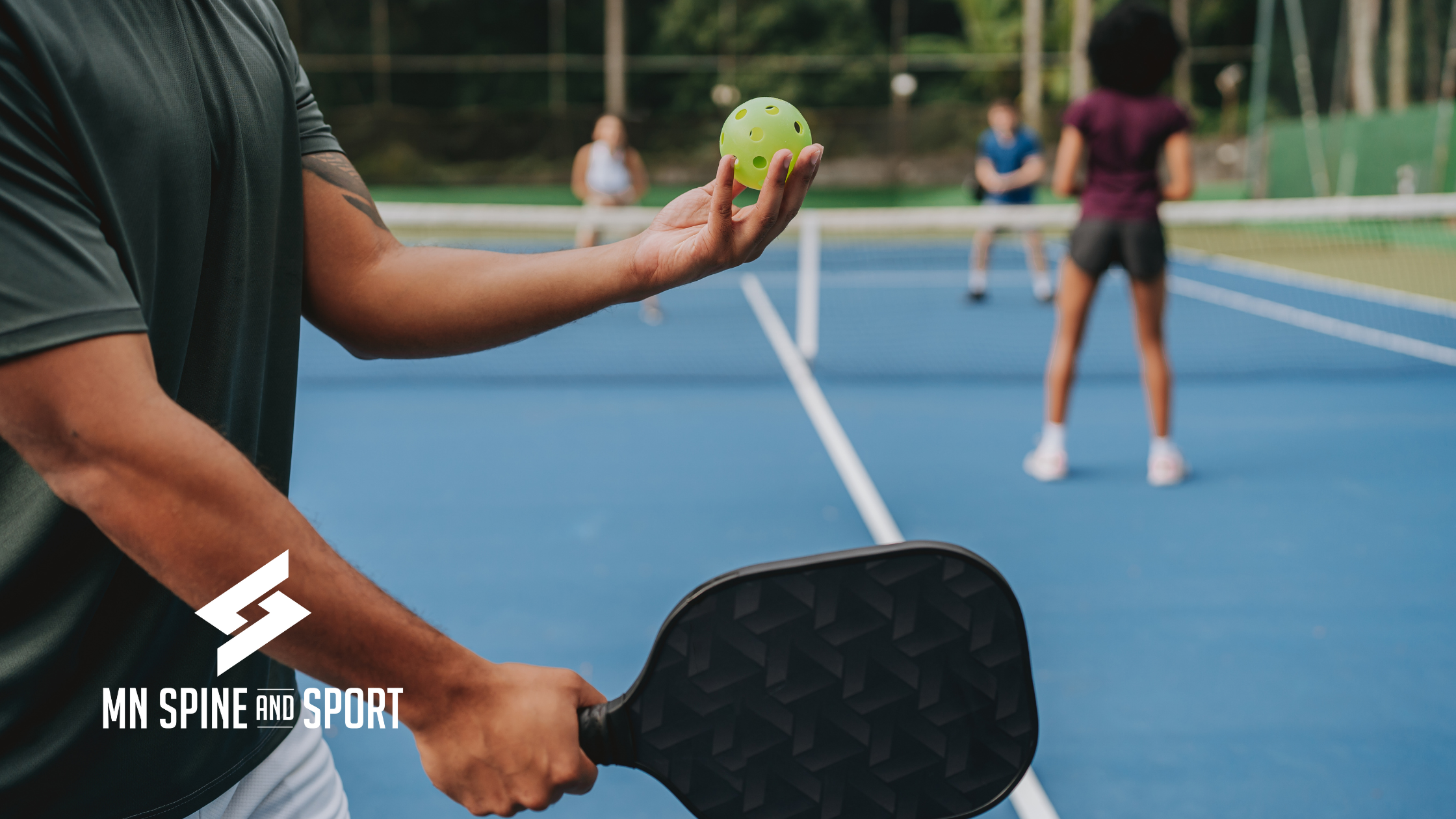
Pickleball is fun, social, and deceptively demanding. Because the court is small and the rallies can be fast, your body ends up doing a lot of repeated movements—quick starts and stops, side-to-side shuffles, sudden reaches, and frequent swings. That combination is why many pickleball injuries fall into two buckets:
- Overuse injuries (tendons, joints, and “nagging” pain that builds over time) and
- Acute injuries (a sudden sharp pain, a twist, or a fall)
Sports medicine clinics have reported a noticeable increase in pickleball-related complaints, especially involving shoulder, elbow, and lower-extremity issues, along with more serious injuries like Achilles ruptures or meniscus and ligament sprains in some cases.
At MN Spine and Sport (Woodbury, MN), our message is simple: don’t wait it out. If you get hurt playing pickleball, getting in to see a doctor promptly—instead of resting for weeks and hoping—often means a faster recovery, fewer setbacks, and a clearer plan. Early, active rehabilitation and timely clinical evaluation are consistent with modern musculoskeletal research emphasizing early appropriate movement, progressive loading, and guided return-to-activity rather than prolonged rest for many common injuries.
Why Pickleball Injuries Happen (Even to Active People)
Pickleball blends:
- Repetitive swinging (upper extremity overuse)
- Quick lateral movement (ankle/knee/hip load)
- Sudden reaching or lunging (hamstring/calf/Achilles strain risk)
- Hard court surfaces (more stress with slips/falls)
Many players ramp up quickly—more play days, longer sessions, tournaments—without giving tendons and joints time to adapt.
That’s why we recommend a simple principle:
Injury → get evaluated early → start the right plan early.
Early assessment helps confirm what’s irritated, what’s safe to keep doing, what to modify, and how to rebuild capacity—before compensation patterns or chronic irritation set in.
The Most Common Pickleball Injuries (and What They Feel Like)
1) Pickleball Elbow (Tennis Elbow / Lateral Epicondylitis)
Pain on the outside of the elbow, often worse with gripping the paddle, backhands, or twisting open jars.
- Typical cause: overuse of the wrist/forearm muscles + grip mechanics
- Common signs: pain with gripping, shaking hands, lifting with palm down
This is widely discussed as a frequent pickleball injury pattern.
How MN Spine and Sport helps (and why early matters):
The sooner you come in, the sooner we can address the true drivers—often including wrist loading, elbow tendon capacity, shoulder blade control, and even neck/upper back mechanics—before the tendon irritation becomes a months-long issue. Early, guided loading is commonly recommended in tendinopathy management frameworks.
2) Shoulder Pain: Rotator Cuff Tendinopathy, Impingement, Biceps Tendon Irritation
Pickleball shoulder pain often builds from repetitive swinging and overhead shots.
- Typical cause: repetitive overhead motion + poor scapular control + load spikes
- Common signs: pain reaching overhead, pain sleeping on the shoulder, weakness
Overuse shoulder patterns (rotator cuff/biceps/impingement-type pain) are frequently cited in pickleball injury writeups.
How MN Spine and Sport helps (and why early matters):
Shoulder pain often lingers when people rest briefly, return too soon, then flare again. Early evaluation lets us calm pain, restore motion, and start a shoulder-specific plan (scapular stability, rotator cuff endurance, thoracic mobility) so you can return with less risk of repeated flare-ups.
3) Back Pain (Lumbar Strain / Facet Irritation)
Pickleball involves rotation, quick reaching, and bending. Overuse + repeated twisting can irritate the low back—especially if hip mobility and core control are limited.
How MN Spine and Sport helps (and why early matters):
Back pain can become “sticky” when movement patterns change (guarding, altered rotation, stiff hips). Getting in early allows us to restore mobility where needed and stabilize where needed—often helping you return faster and preventing recurring episodes.
4) Achilles Tendon Pain (and Why It Shouldn’t Be Ignored)
Short bursts, lunges, and sudden accelerations can overload the Achilles—especially early in the season or after a break. More severe pickleball injuries reported clinically have included Achilles ruptures.
How MN Spine and Sport helps (and why early matters):
For Achilles pain, the best outcomes often come from timely assessment + progressive loading (not “just rest”). Early care helps you avoid the cycle of “rest → feel better → play → flare again,” and helps ensure you’re progressing safely.
5) Ankle Sprains
Lateral shuffles and sudden changes of direction can lead to ankle sprains—commonly listed among pickleball injuries.
How MN Spine and Sport helps (and why early matters):
Early management matters because unresolved ankle sprains can lead to persistent instability. We focus on restoring motion, reducing swelling and pain, and rebuilding balance and strength early—so you don’t keep “rolling” the ankle.
6) Knee Pain: Meniscus Irritation, Ligament Sprains, OA Flares
Knee symptoms can flare from hard court play and repeated deceleration. More severe injuries can include meniscus and ligament sprains.
How MN Spine and Sport helps (and why early matters):
Early evaluation helps determine if your knee pain is primarily overload/irritation versus something needing imaging or referral—and it gets you on a strength and control plan ASAP, which is often the difference between a short setback and a long one.
How MN Spine and Sport Treats Pickleball Injuries (Our “Return to Court” Approach)
1) A clear diagnosis + plan—right away
After an injury, uncertainty causes two problems: doing too much too soon, or resting too long. We help you find the middle ground:
- what to stop temporarily
- what to keep doing safely
- what to start now to speed healing
2) Hands-on care when appropriate
We work to reduce pain, restore mobility, and improve mechanics so you can move confidently as you rebuild.
3) Rehab that matches pickleball demands
Pickleball requires:
- lateral strength and deceleration
- single-leg control
- shoulder blade stability and rotator cuff endurance
- grip/forearm capacity
- trunk rotation control
So your rehab should reflect that—not generic exercises forever.
4) A real return-to-play progression
We guide you from:
- pain control → range of motion → strength/endurance → reactive agility → court-specific drills → full play
This “graded exposure” approach aligns with modern rehab principles and return-to-sport best practices.
Pickleball Injury Prevention: 8 Practical Tips That Actually Help
Medical and sports medicine guidance commonly emphasizes warming up, gradual progression, strength training, and proper footwear for court sports.
- Warm up 5–8 minutes (brisk walk/light jog, lateral shuffles, arm circles)
- Do dynamic mobility (ankles/hips/thoracic spine/shoulders)
- Strength train 2x/week (calves, glutes, rotator cuff, scapular muscles)
- Build volume gradually (avoid doubling play time overnight)
- Use court shoes for lateral stability
- Use legs/hips/trunk for power (not just arm/shoulder)
- Rotate activities (avoid 6–7 days/week if you’re not adapted)
- If you feel a new pain—get evaluated early so you can treat it correctly and avoid a chronic problem.
Q&A: Pickleball Injuries (With the “Don’t Wait” Plan)
Q: Is “pickleball elbow” the same as tennis elbow?
A: Most of the time, yes—pain on the outside of the elbow related to forearm tendon overload. Because tendon issues can become persistent, the best move is to get in to see a doctor at MN Spine and Sport early, so we can confirm the diagnosis and start the right loading program immediately—often shortening recovery time.
Q: Should I stop playing completely if my elbow or shoulder hurts?
A: Not automatically. Many overuse injuries respond best to smart modification + early targeted rehab, not weeks of total rest. If you come in quickly after symptoms start, we can tell you exactly what to avoid, what’s safe to keep doing, and what exercises to begin now—so you return sooner and with fewer flare-ups.
Q: I tweaked my knee or ankle—should I “give it a week” first?
A: If it’s new and affecting how you walk, squat, or change direction, it’s better to get evaluated right away. Early assessment reduces guesswork, prevents compensations, and helps you start the right progression immediately—which is often associated with a quicker return to activity in modern rehab models.
Q: Why does my Achilles feel tight the morning after playing?
A: Morning stiffness after activity is a common Achilles tendinopathy pattern. The best next step is not to wait for it to “go away on its own,” but to get in to MN Spine and Sport quickly so we can identify the irritability level, start an appropriate loading plan, and reduce the risk of long-term tendon trouble.
Q: Do I need an MRI right away?
A: Not always. Many pickleball injuries improve with conservative care and structured rehab. But the fastest way to know what’s appropriate is a timely exam—come in soon after the injury so we can decide whether conservative care is best, or whether imaging/referral is warranted based on your presentation.
Bottom Line: Don’t “Wait and See”—Get a Plan and Recover Faster
Pickleball injuries are common, but long recoveries don’t have to be. In many cases, early evaluation and early guided rehab are associated with better outcomes than prolonged rest and delayed care.
If you’ve been injured—or even if a new pain just started—schedule a visit with a doctor at MN Spine and Sport so we can:
- confirm what’s going on
- build a clear recovery plan
- help you return to pickleball with confidence
Move Better. Feel Better. Live Better.