

If Your Tendon Pain Keeps Coming Back, You’re Not Alone
Tendon pain has a frustrating pattern: it eases when you rest… and then returns the moment you try to train again. Many people assume that means they just need more rest. But tendons don’t work like that.
In many cases, chronic tendon pain (often called tendinopathy) is less about “inflammation” and more about a tendon that’s been stuck in a cycle of:
- too much load (repeated stress)
- not enough recovery
- poor mechanics or weak links in the chain
- and eventually, a tendon that becomes sensitive and less tolerant to activity
That’s where shockwave therapy can be a powerful tool—especially when pain has been lingering for weeks or months and “the basics” haven’t solved it.
At MN Spine and Sport in Woodbury, MN, we use shockwave as part of a bigger plan: the right diagnosis, the right loading strategy, and the right progression so you can get back to life and training without repeated flare-ups.
What Is Shockwave Therapy?
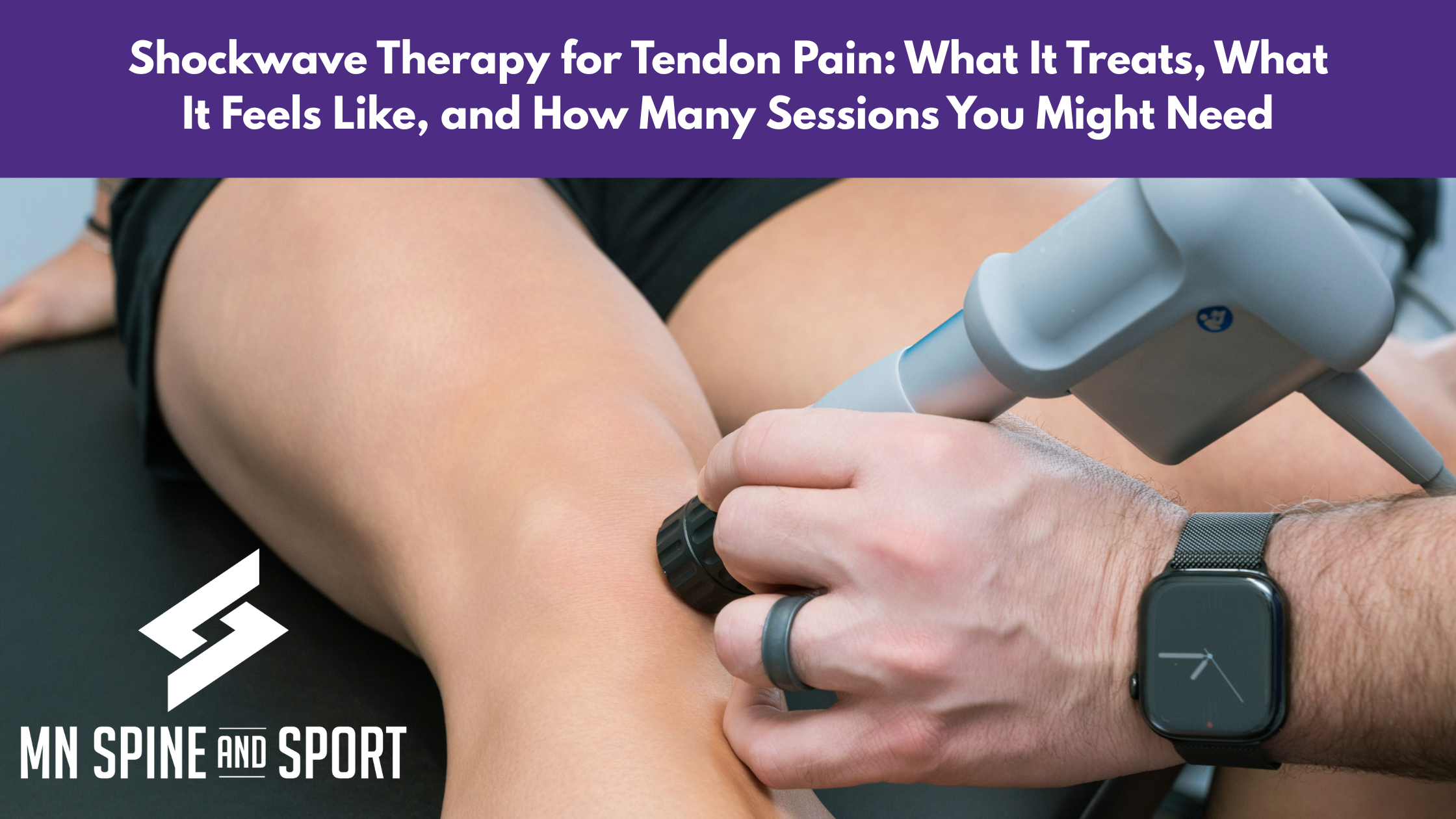
Shockwave therapy (often called Extracorporeal Shockwave Therapy or ESWT) uses acoustic pressure waves delivered through a handheld device. These waves create a mechanical stimulus in the affected tissue.
In simple terms: it’s a way to “wake up” stubborn tissue and support the body’s healing and pain-modulation processes.
Shockwave is commonly used for chronic conditions involving tendons and connective tissue—especially when symptoms have been present long enough that typical rest and stretching haven’t worked.
What Shockwave Therapy Is Not
Shockwave therapy is not:
- A massage (though it can feel like tapping pressure)
- The same thing as ultrasound
- A “one-and-done” miracle cure
- The right fit for every diagnosis
The best outcomes happen when shockwave is used for the right person, the right condition, at the right stage, and paired with a smart rehab plan.
What Conditions Does Shockwave Therapy Treat Best?
Shockwave is most commonly used for chronic tendinopathies and stubborn connective tissue pain, such as:
Heel & Foot
- Plantar fasciitis / chronic heel pain
- Plantar fascia degeneration
- Certain stubborn foot tendon issues (case-dependent)
Elbow
- Tennis elbow (lateral epicondylalgia)
- Golfer’s elbow (medial epicondylalgia)
Achilles & Calf Complex
- Achilles tendinopathy (insertional or mid-portion)
- Chronic calf/ankle tendon overload patterns
Knee
- Patellar tendinopathy (“jumper’s knee”)
- Certain chronic tendon-related knee pain patterns
Shoulder & Hip (Case dependent)
- Certain rotator cuff tendinopathies
- Some chronic tendon insertions (assessment matters here)
Key point: shockwave is usually best when pain has been present long enough to become “stuck,” or when tendons are repeatedly flaring with activity.
How Does Shockwave Therapy Work?
A tendon that stays painful for months is often stuck in a cycle where it:
- doesn’t tolerate load well
- stays hypersensitive
- doesn’t remodel properly
- triggers pain even with normal activity
Shockwave may help by:
- Stimulating local circulation and metabolic activity
- Encouraging tissue remodeling (supporting tendon adaptation)
- Modulating pain sensitivity (changing how the area perceives pain)
- Supporting the tendon’s ability to tolerate progressive loading again
The exact mechanisms are complex, but the practical takeaway is simple: shockwave can help chronic tendon pain move forward when it’s been stalled.
What Does Shockwave Therapy Feel Like?
Most people describe shockwave as:
- rhythmic tapping or pulsing pressure
- “intense but tolerable”
- sometimes a little uncomfortable at the most tender spots
- often easier as the session goes on
A good provider will adjust intensity to match your tolerance and the clinical goal. You should not feel like you’re being punished. Productive treatment is targeted and appropriate—not brutal.
Common sensations during and after:
- Mild soreness in the area afterward (similar to a hard workout)
- Temporary sensitivity for 24–48 hours
- Many people notice gradual improvements over a series rather than instant results
How Long Is a Shockwave Session?
Shockwave sessions are typically short—often just a few minutes of treatment time on the targeted area. The visit may include:
- quick reassessment of symptoms
- shockwave application
- rehab progression updates (this matters!)
- activity modification guidance
The point is efficiency: targeted treatment plus a clear plan.
How Many Sessions Do You Need?
This depends on:
- how long you’ve had the problem
- which tendon is involved
- how irritable the tissue is
- how consistent you are with the rehab plan
- what your activity demands are (runner vs desk job vs athlete)
That said, many shockwave plans involve:
- a series of sessions
- spaced over multiple weeks
- paired with progressive strengthening and load management
Important: shockwave is often a “catalyst.” The rehab plan is what makes the change stick.
Why Shockwave Works Best With Rehab (Not Instead of Rehab)
Tendons don’t just need pain relief—they need capacity. That means the tendon must become stronger and more tolerant to load.
If shockwave helps reduce pain sensitivity and supports healing signals, rehab is what:
- teaches the tendon to handle load again
- improves mechanics and strength in the chain
- prevents recurrence
A simple example:
- Plantar fasciitis improves faster when you combine tissue support + foot/calf strengthening
- Tennis elbow improves when you address gripping load + shoulder/scapular mechanics + forearm strength
- Achilles improves when you progress calf strength and manage running volume
Shockwave without a loading plan is like changing the oil but never maintaining the engine.
Who Is a Great Candidate for Shockwave?
You may be a strong candidate if:
- You’ve had tendon pain for weeks to months
- You’ve tried rest, stretching, basic rehab, and it keeps returning
- Pain limits walking, training, or daily function
- You want a conservative option before injections or surgery
- You’re willing to follow a plan (load modification + strength progression)
Who Might Not Be a Fit (Or Needs a Different First Step)
Shockwave might not be the first choice if:
- The problem is clearly acute inflammation from a sudden injury (not always, but often)
- The pain is driven primarily by a nerve issue rather than tendon tissue
- There are red flags (severe swelling, suspected fracture, systemic symptoms)
- The diagnosis isn’t actually tendon-related
That’s why the evaluation matters. The goal is to use the right tool for the right problem.
What to Do (and Not Do) During Shockwave Treatment
Do:
- Follow activity modifications (especially around impact)
- Do your rehab exercises consistently
- Track your pain response after sessions
- Communicate what you’re feeling so dosage can be adjusted
Don’t:
- Test it aggressively the same day (“let’s see if I can run 5 miles now”)
- Add new high-intensity workouts during the first couple of weeks
- Assume the tendon is “healed” because pain is temporarily reduced
Your tendon needs time to remodel. We want steady progress, not yo-yo flare-ups.
The MN Spine and Sport Shockwave Approach (Why Outcomes Matter More Than Gadgets)
At MN Spine and Sport, we’re not interested in “cool tools” unless they create real results.
When we use shockwave, we pair it with:
1) A clear diagnosis
We determine whether it’s:
- tendinopathy vs ligament vs fascia vs nerve
- insertional vs mid-portion tendon involvement
- mechanical overload vs referred pain driver
2) Load management guidance
We’ll tell you what to reduce temporarily so you stop reinjuring it:
- running volume
- jumping
- gripping work
- repetitive pressing/pulling
- long standing/walking (for heel issues)
3) Progressive strengthening
This usually includes:
- isometrics (pain calming)
- slow heavy resistance progressions
- endurance work for the tendon’s role
- proximal strength (hips/shoulders) to unload the tendon
4) Mechanics and movement correction
Because the tendon doesn’t exist in isolation. We assess:
- foot/ankle mechanics
- hip control
- shoulder blade mechanics
- posture and movement patterns
- sport/work demands
That’s how we help people not just “feel better,” but stay better.
FAQs
Is shockwave therapy painful?
It can be uncomfortable at tender spots, but it should be tolerable. Intensity is adjustable.
Is shockwave therapy the same as ultrasound?
No. They are different technologies with different effects.
Will shockwave fix my tendon without exercise?
Usually no. Most tendons need progressive strengthening and load management for lasting results.
How quickly will I notice results?
Some people notice changes after a session or two, but many notice gradual improvements across the series.
Can I work out while doing shockwave?
Often yes—with modifications. The goal is to keep you active without repeatedly aggravating the tendon.
Ready to Find Out If Shockwave Is Right for You?
If you’ve been dealing with stubborn tendon pain—heel pain, tennis elbow, Achilles pain, jumper’s knee, or other chronic tendon problems—shockwave may be the missing piece.
At MN Spine and Sport in Woodbury, MN, we’ll evaluate your condition, tell you honestly if shockwave is appropriate, and build a plan that helps you return to activity stronger.
Book your evaluation today.
Move Better. Feel Better. Live Better.
https://mnspineandsport.com/schedule-now/